[2/1/2026] Note: I left St. Louis 1/31/26, but thanks to air travel, the dates and times of posts may be a bit off.
Greetings, friends and family! Thanks to modern technology, I’m currently 35,000 feet above the Atlantic Ocean on the second leg of my three flight journey to Uganda. (Post-script: the airline sneaked in a fourth leg. I flew St. Louis to Washington, D.C., changed planes, flew to Brussels, changed planes, flew to Rwanda then Uganda … four legs, but only changed planes in D.C. and Brussels).
My siblings and I attended St. Elizabeth Catholic School in Granite City, Illinois, USA. One of my nephews is currently a student there.
I loved my Catholic education. I love St. Elizabeth. If I had had kids, I planned on raising them as Catholics and sending them to Catholic School. That said, my relationship with Catholicism is complicated. Imagine my surprise, then, that I am flying halfway around the world to spend a week with a Catholic priest in his home country of Uganda. Life is crazy.
Father Alfred came to St. Elizabeth six years ago. Since I volunteer there, I’ve watched him move through the world with an unwavering grace. He has led that church and school flawlessly through the pandemic; has helped hundreds of schoolchildren through normal kid turbulence and devastating traumas; guided students and parishioners with an incredible kindness and patience. He’s a true holy man. Weirdly, the only people I’ve met like him are Buddhist monks I encountered at the Buddhist Temple in Chicago. The man is truly holy.
Fr. Alfred came from a small, impoverished village in Uganda, Africa. He would walk hours barefoot to the nearest village to go to a small Catholic school. There were no walls, no books, no water, no desks. The school was just teachers, pieces of wood covered in chalkboard paint, devotion, and will. Eventually, he became a priest through the Archdiocese of Mbarara. From there, he went to Rome for a few years, then to the United States through Chicago, IL, Springfield, IL, and now Granite City, IL. He holds a PhD from Loyola in Healthcare Mission Leadership and Management.
A few years ago, Fr. Alfred said he wanted to start sending groups from St. Elizabeth (St. E.) to Uganda. I immediately volunteered. I’m pretty sure he thought I wasn’t serious, but he underestimated my crazy.
So, here I am, brushing my teeth in a Belgian airport alongside a bunch of African ladies, preparing to board an 11 hour flight to Uganda.
What was supposed to be a group going to Uganda ended up being my flying over to meet Father and one other traveler. So, it’s not really a group. We plan on doing non-profit work while we are in Father’s village at his elementary school. We’ll also be assisting this organization: https://www.tenbythree.org
We’ve been fundraising for the school, and the ultimate goal is to establish a sister school / church relationship between St. Ellizabeth and Father’s village, fostering travel between the two communities.
No pressure to donate, but you can read more here:
https://www.gofundme.com/f/st-augustine-catholic-school-uganda-building-classrooms
At the airport this morning with MPT. Maybe it was yesterday morning. This time travel has my head spinning:
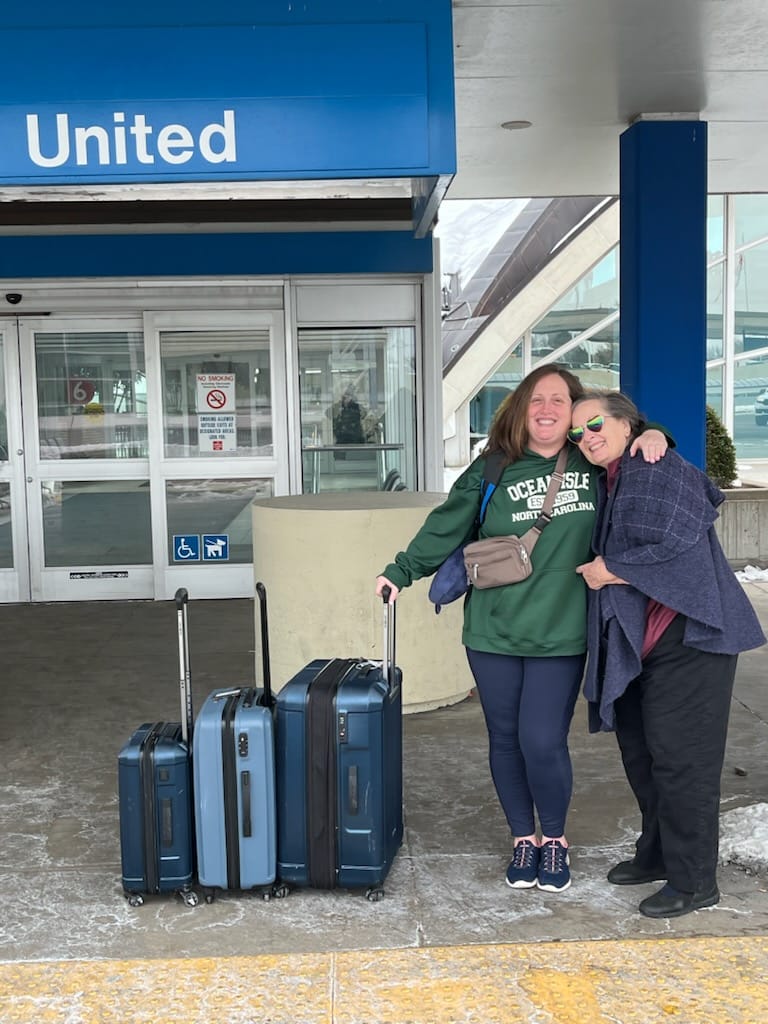
I’m pretty sure my Grandmas are doing a little dance in their very Catholic graves because of what I’m hauling to Uganda: Fr. Alfred uses every last ounce of available luggage space to ship goods back and forth between the states and Uganda. So, travelers basically mule donations of Catholic stuff instead of illicit drugs. A few weeks ago, I found out what I’m taking in one of my suitcases … FIFTY POUNDS OF BRAND NEW CHALICES. My exact words? “I’m sorry, Father, but what? You want me to take a suitcase of chalices to Uganda?”
That’s a lot of pressure. I guess I should feel honored. Instead, I feel like Indiana Jones. Before my trip, I started referring to the chalices as the “holy grails.” (More on that later.)
[2/2/2026] For those curious, the middle, light-blue suitcase in the picture above holds the holy grails. The big blue suitcase holds deflated soccer balls, a tiny air pump, t-shirts to donate, and a few snacks. The snacks are for me. Everything else is for the kids.
Made it! Anxiously waiting at baggage for the holy grails. Of course they were one of the last suitcases to spit out of the luggage chute.
Wow. Africa is HOT.
Father picked me up at the airport. Please notice my grip on the light blue suitcase with the holy grails. I was terrified something was going to happen to it. See that smile? It’s fueled by sweat, relief, and delirium:
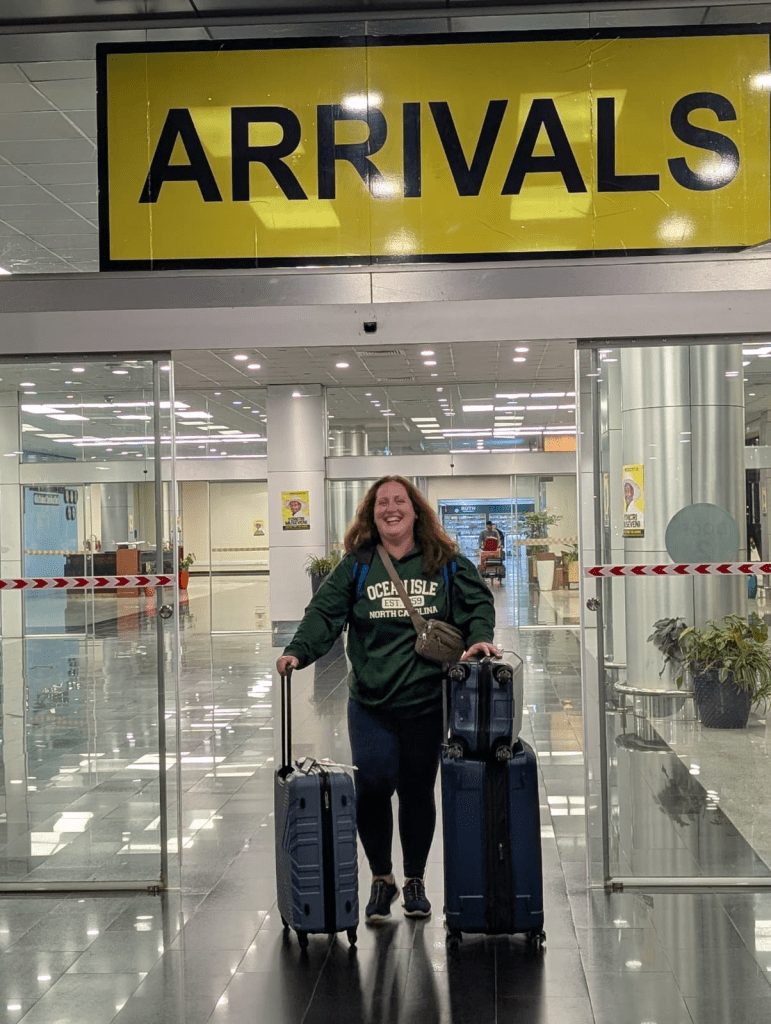
Since my flight landed at 11pm Uganda time (I still don’t know what day it is), we stayed at a convent about a mile from the airport. Pulling up to that convent, I immediately regretted my decision to come visit Uganda. That convent was a fully locked-down compound. It had 20 foot walls with concertina wire around the top. The front gate was solid wood and opened by a security guard. Later, I came to realize that type of security is somewhat typical for nicer homes here. “What have I gotten myself into?” played on repeat in my head.
Uganda is a misunderstood country. I learned that after my initial impression of the razor-wire nunnery.
[2/3/2026]
What a day. After no sleep (ugh … jet leg), at 7am, Fr. and I left the convent where we stayed last night. The plan was to drive from Entebbe to the hotel in Ntungamo where me and the other lady in our group are staying the next three nights. (Fr. stays at churches because it’s free.)
“I and the other lady in our group.” Not “me and the other lady in our group.” Apologies to my mother. (Disclaimer: this travelogue is being typed on my phone with spotty internet service and rolling power blackouts. I apologize in advance for misspellings and grammatical errors. Please do not hold them against me or my mother, the retired English teacher.)
My jaunt into Uganda started with an absolute downpour. Torrential rains. Thanks to a family member, “Africa” by Toto has been in my head all day. “It’s gonna take a lot to drag me away from you / There’s nothin’ that a hundred men or more could ever do / I bless the rains down in Africa.”
Within minutes of the rain subsiding, riding shotgun in a car from the Mbarara Archdiocese, along a road in Kampala, the Ugandan Capitol, a wall of sensation descended. I was not prepared.
There were people EVERYWHERE. They were all over the sides of the road in shops. Some shops are made of materials like we have here, but they’re mostly made of tin or some other rickety material. The further into the countryside we went, the more primitive the shops became. In these shops, furniture, food, animals, clothes, medicine, bricks, tile, wigs, lined the streets for miles. The smell of the traffic permeated not just the nose, but the skin. You could feel the exhaust. You could feel the chaos.
Ugandans travel mainly on Boda Boda motorcycles – like a dirt bike, but slightly larger – weaving in and out of traffic like dancers, honking and yelling at one another … not out of anger, but because some Ugandans are just naturally loud, as I found out today.
It was the strangest sensation to be swallowed up by all of this choreographed chaos. It makes you feel like you’ve disappeared. But, at the same time, I attracted a lot of attention. Fr. said a lot of people here have never seen a white woman, so, just me riding in a car caused people to stop and stare. When the guys piled three high on the Boda Bodas stared, since they were inches away, it really became a problem. They have zero margin of error on those things.
In the city, the scenery is somewhat like we see here. There’s electricity. Buildings are made of sturdy materials. Once you are out of the city, though, things change. There are still shops lining the streets, but they’re made of whatever material people can find: discarded wood, plastic, tarps, metal fragments, etc. Out in the rural areas, mixed in with all of these ramshackle shops, people, and commerce, is poverty. Trash is everywhere. Kids dig through piles of debris, adults rake through red muddy junk looking for something to sell or eat. Many vendors and the shop patrons live in shacks made of tin or wood thrown together in the shape of a dwelling. There’s no water except for the rich, no electricity.
This scene goes on for miles. I came to learn this is a standard way of life here. We drove for 10 hours today and it was the same over and over again. Again, I was not prepared. One has to compartmentalize when presented with such experiences. But, that’s why I came here … real-life experiences.
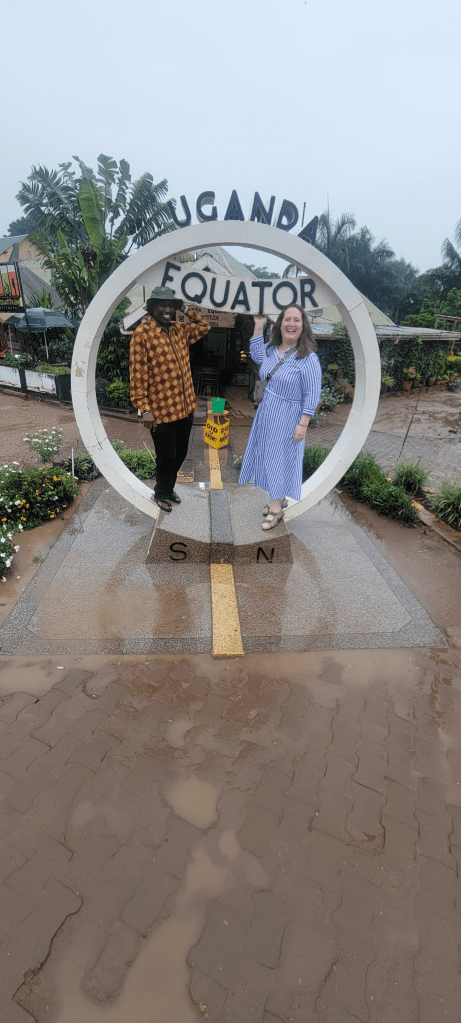
During this all-day drive, we crossed the equator. This was my first time doing this, so I was very excited. You can see how wet everything was. Cue the Toto song.
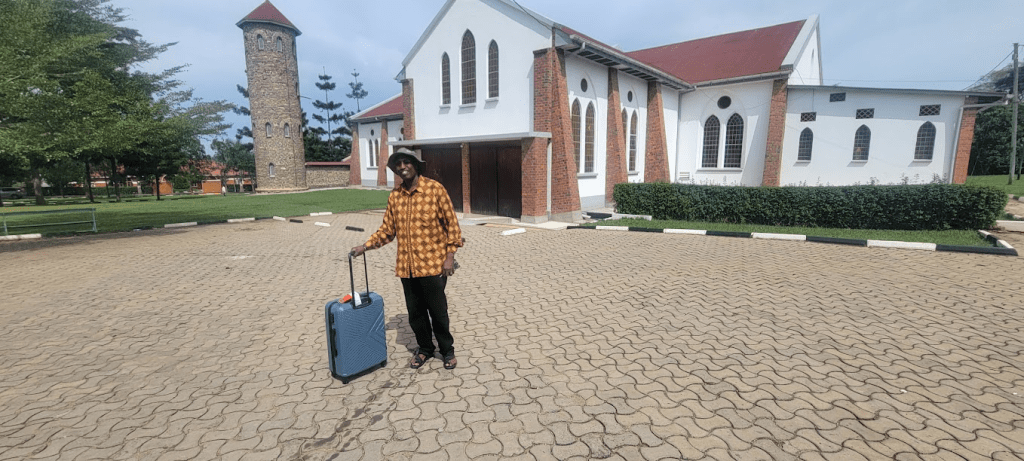
Lingering in the back of my mind through all of this travelling was the fact that I still had the chalices. I was anxious to no longer be responsible for them. During our first day road trip, Fr. and I finally dropped the chalices off at the Mbarara Cathedral, at the Archbishop’s office. Unfortunately, the Archbishop was not there, but we left them with his second-in-command, the Chancellor.
When I agreed to haul the chalices to the other side of the world, I did not know the story behind them. I do now. The Knights of Columbus is a Catholic fraternal service organization. Their members are known as Knights. They do great work all over the world. The Granite City Council is very active and a staunch supporter of the Catholic schools and churches in the area. The Knights are a benefit to our community.
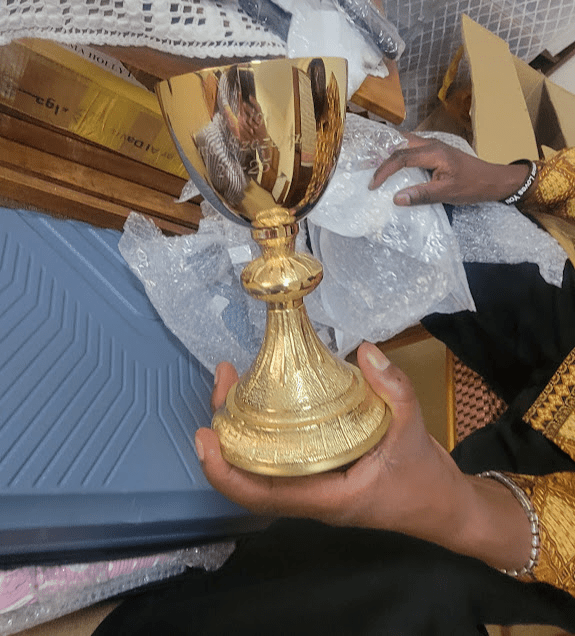
As I learned through my trip, 4th Degree Knights, upon their death, are honored with gold-plated chalices that are engraved with their names and other markings. These chalices and patens are sent around the world, often to new parishes in under-developed countries, where they are blessed, then used during mass. The chalices are a beautiful tribute to the deceased Knights and ensure the Knights are remembered.
Father at the Mbarara Cathedral with the suitcase of chalices:
The unveiling of the chalices with Father Alfred and the Chancellor:
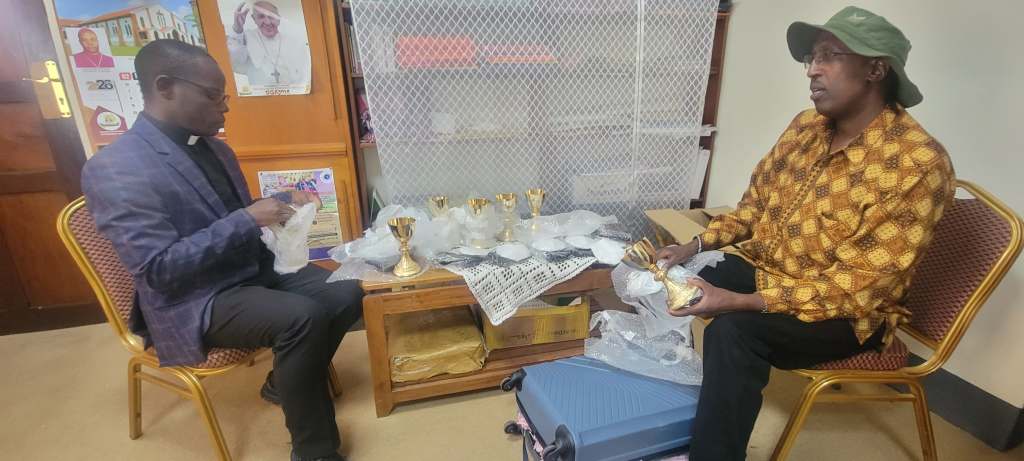
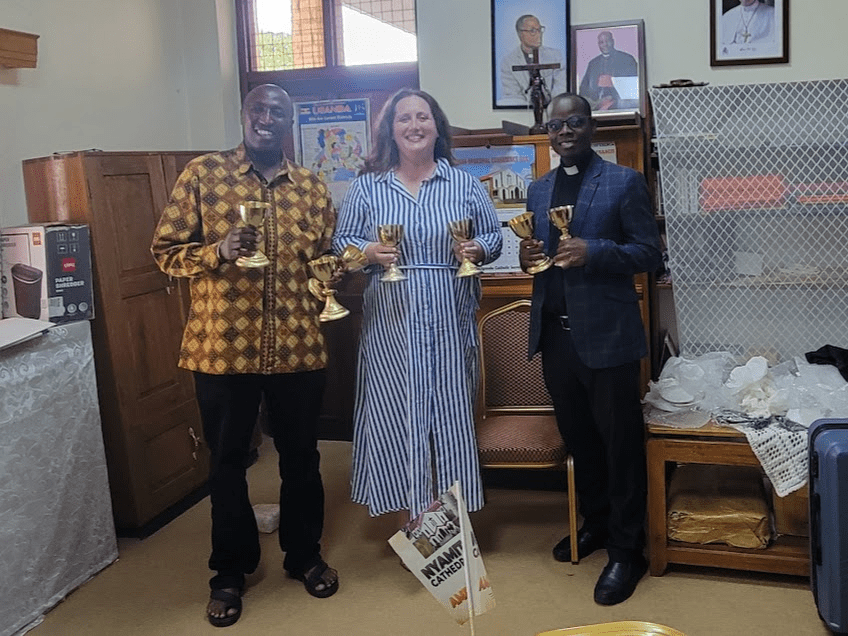
Below is Roy Logan’s chalice. The Logan family is one of those families that’s been intertwined with mine since childhood. Such great people. It was an honor to carry to Uganda Mr. Logan’s chalice and the chalices of the other men.
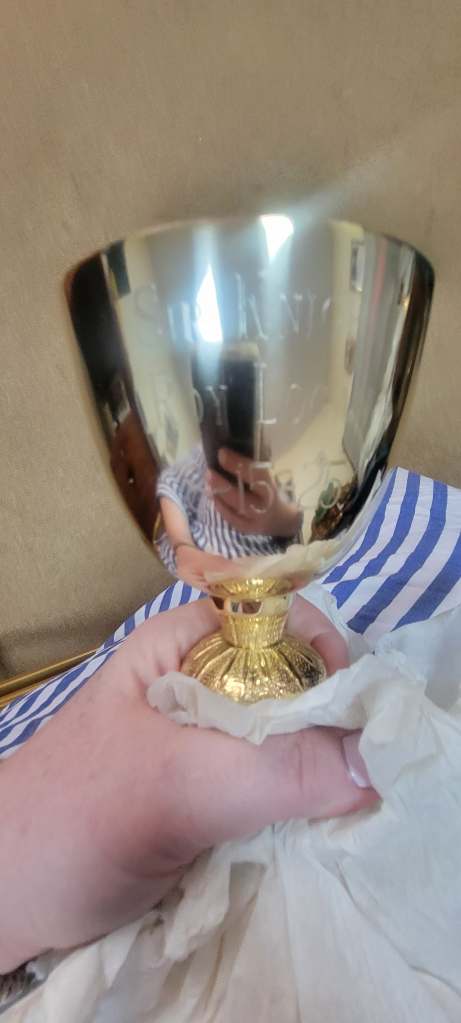
The chalices I transported to Uganda were for Roy Logan, Charles Palus, Al Jenness (he had two), Emilio Campos, Phillip Achenbach, and Edmund Szczepanik.
Charles Palus:
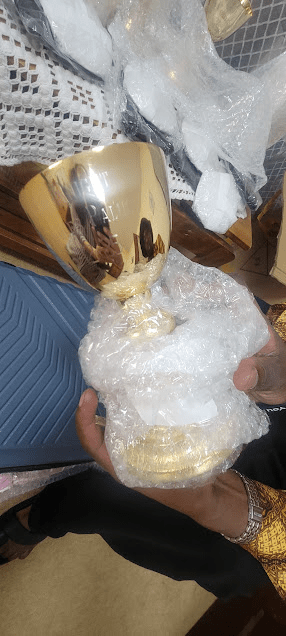
Al Jenness:
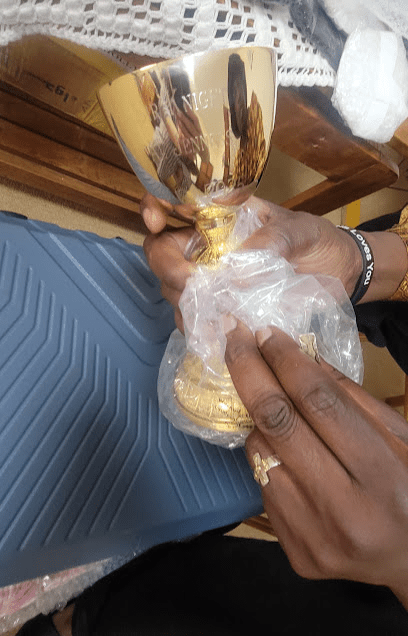
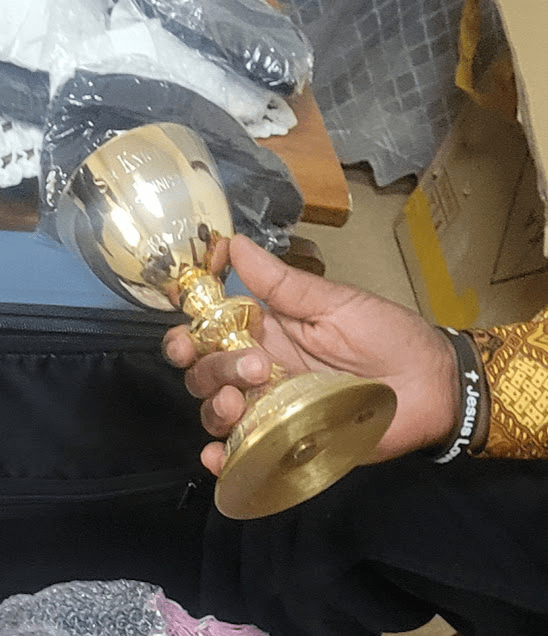
Emilio Campos:
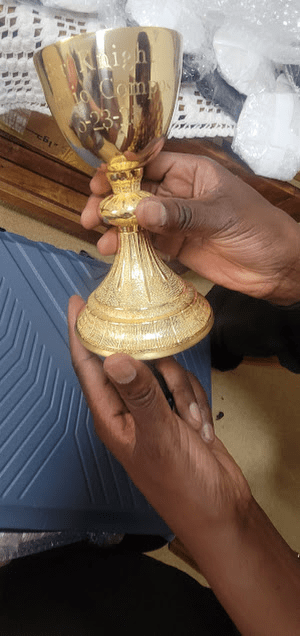
Phillip Achenbach:
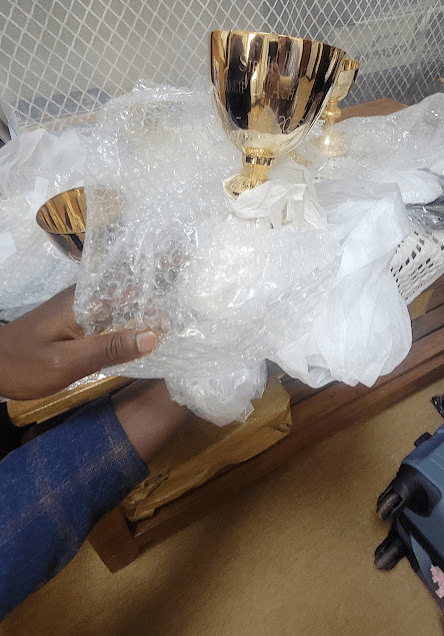
Edmund Szczepanik:
After safely leaving the chalices at the Cathedral, our first meal stop was at a popular buffet restaurant Father enjoys. This moment had me full of dread. First, I was not sure my digestive system was going to handle Ugandan food. Second, we still had hours of driving ahead of us, and access to Western toilets was not guaranteed. Third, I am allergic to beef with disastrous consequences, and I had no idea how to say “beef” in whatever language it was they were speaking.
I thought my best course of action was to follow closely behind Father and let him tell me what everything was and whether or not I should eat it. I tried to decline a third piece of chicken, and the woman serving followed me to the table chastising me. Ugandans like to feed people, and they do not allow you to politely decline. As a result, I ended up with a plate full of delicious food I could not identify, staring at a big fish floating in a bowl of soup, laughingly arguing with a priest over whether or not I needed more to eat. Food and floating fish seen below:
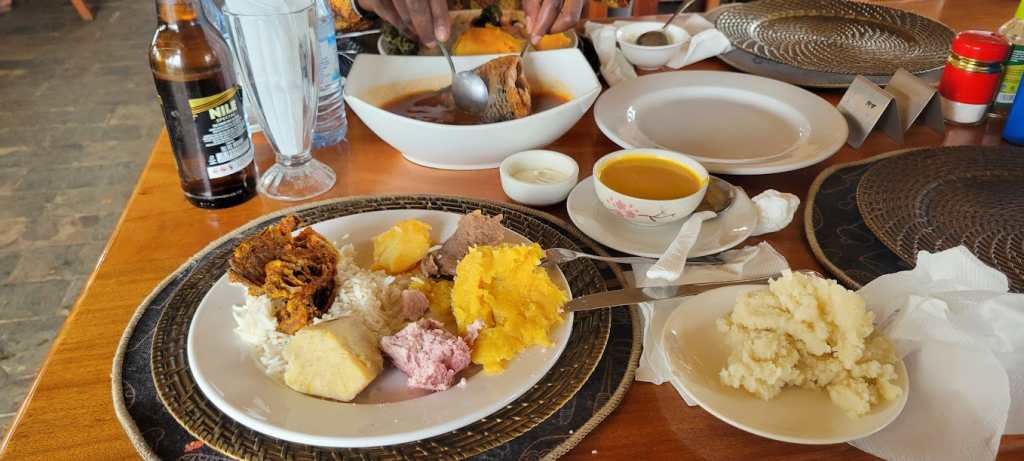
At the meal, I tried my first Ugandan beer. By the time I left the country, I’d sampled most of the beers there. That Nile brand above will make a few more appearances in this blog.
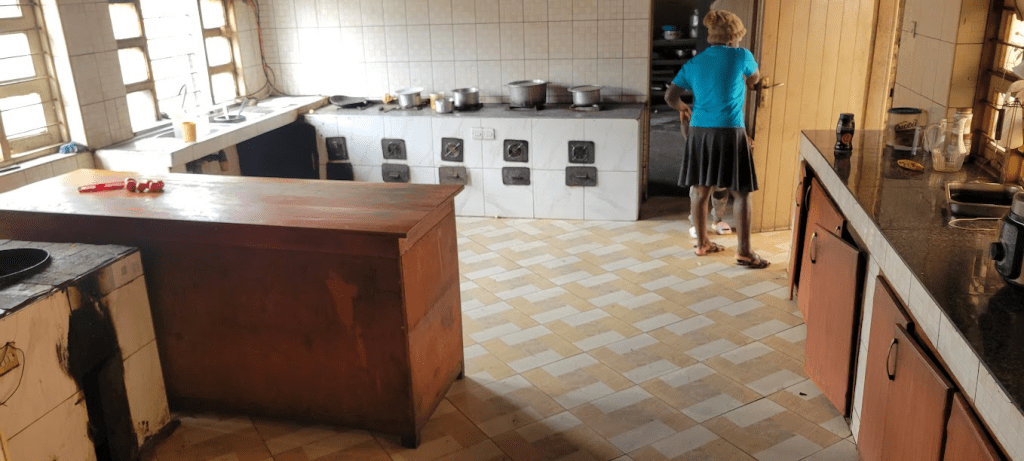
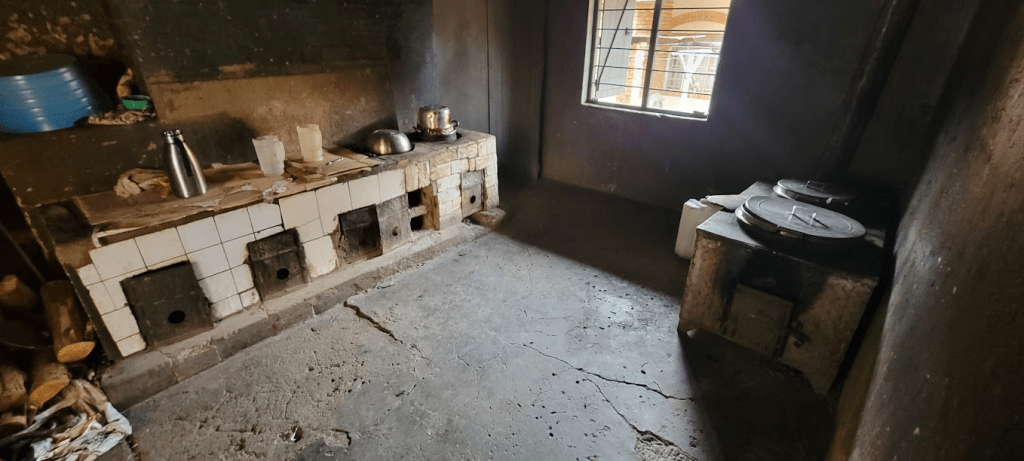
Near the Cathedral compound in Mbarara, at the place Father stays when he is home in Uganda (it might have been a seminary), we were given a brief tour. Since it was summer, the flowers were blooming and everything was green. Since it was a Catholic facility, everyone was peaceful and the world around us was serene. Below are a few photos from our stops that day.
Kitchens:
My mother is a genealogy nerd and has had me trapsing through cemeteries since I was a kid. Maybe it was that, or maybe it was the chalices, but Ugandan burials and death rituals were on my mind. Father explained that most people bury their dead on their family land. More than once, he pointed out concrete slabs where families had lain loved ones to rest in their front yards. It was fascinating. We also visited a cemetery near the Mbarara Cathedral where only priests are allowed to be buried. Father said he wants this to be his final resting place. I could see why. It was gorgeous. I told him I would come visit him:
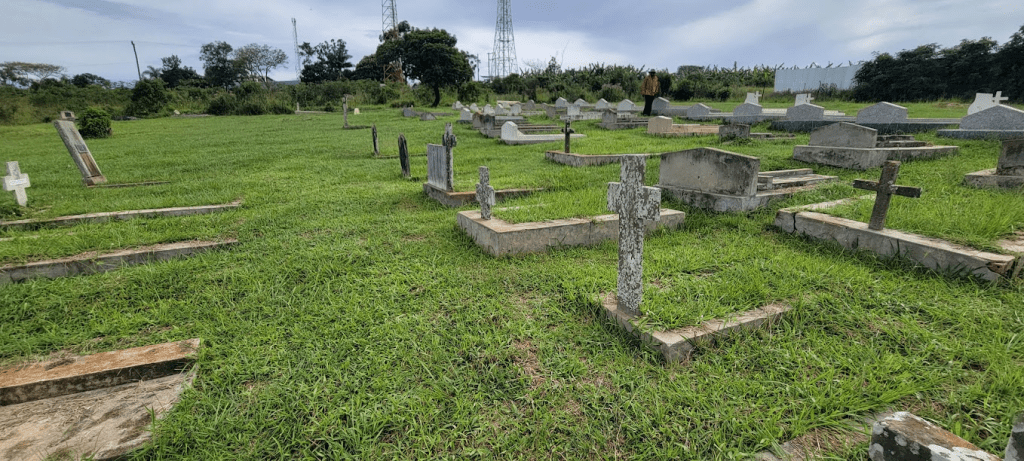
As I silently walked the consecrated ground of that Catholic cemetery, contemplating life and death, and paying homage to generations of Ugandan priests, suddenly, as if sent by the universe as a reminder of the complicated, beautiful world in which we live … an Islamic call to prayer rang forth from the valley below.
After a day of travel across Uganda, Father and I eventually made it to the serene, glorious hotel where I’ll spend the next three nights. We connected with Cindy, the other traveler from Granite City, who had been in country a few days already.
I was jet lagged, exhausted, and overwhelmed, but incredibly happy. I promptly booked a massage that was the equivalent of 10 U.S. dollars and later did some sink laundry. (More on that later.)
 Adventures With Amelia
Leave a comment